
Project Details
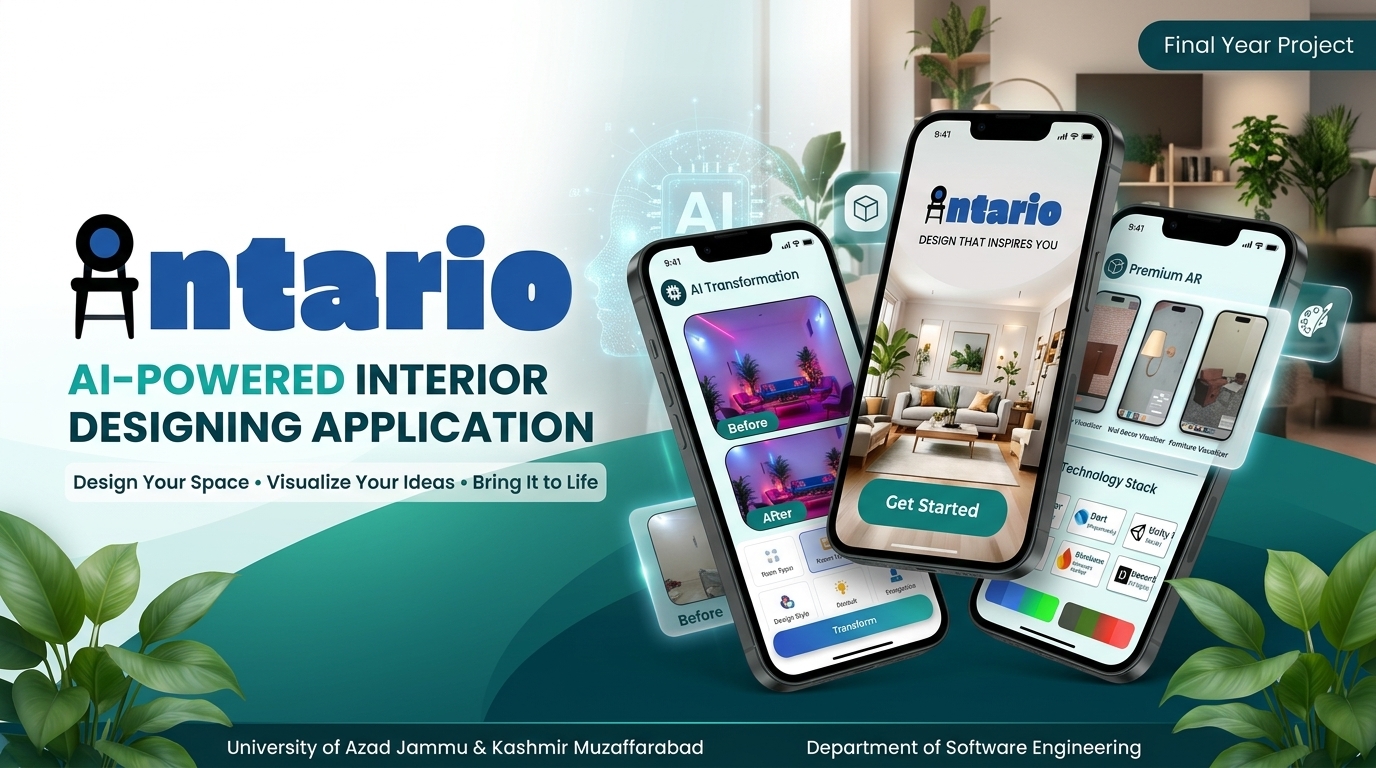
Intario AI
AI Powered Interior Designing Application
Project Overview
Intario AI is a mobile application developed as a BS Software Engineering Final Year Project. It bridges the gap between conceptual design and physical reality by combining deep generative computer vision with real-time Augmented Reality (AR).
Users can upload a single 2D photograph of an existing room or exterior facade to generate photorealistic redesigns across 31 room types, 50 design styles, 31 garden styles, 20 color schemes, and 7 seasonal themes. To physically validate designs at 1:1 scale, the platform integrates an embedded spatial AR subsystem (Google ARCore & Unity 6) that procedurally meshes physical walls, visualizes tiled wallpapers, calculates live room dimensions, and anchors 3D furniture and wall art directly in physical space.
Problem Statement
- Prohibitive Professional Costs: Interior designers and 3D architectural staging agencies charge substantial consultation fees(often thousands or hundreds of thousands of PKR/rupees) just for initial conceptual sketches, making professional visualization inaccessible to average homeowners and tenants.
- Cognitive Visualization Gap: Everyday consumers struggle to mentally project 2D paint swatches, material chips, or catalog photos into real-world 3D spaces with existing lighting, proportions, and textures.
- Iterative Material & Financial Waste: Traditional trial-and-error (purchasing sample paint cans, painting test patches, or returning ill-fitting furniture) wastes time, money, and raw materials.
- CAD Complexity & Tool Fragmentation: Traditional tools (AutoCAD, 3ds Max, SketchUp) require high-end desktop workstations and steep learning curves, while existing mobile apps are fragmented offering either flat 2D image filters or isolated 3D models without holistic generative styling.
Solution
Intario AI provides an accessible, mobile-first design laboratory running directly on standard consumer smartphones:
- Generative Computer Vision: Automates photorealistic 2D space reimagining across 12 generative features using asynchronous cloud diffusion pipelines.
- Interactive Comparative Inspection: Incorporates a custom, touch-draggable Before/After split comparison slider rendering at a sustained 60 FPS.
- On-Device Real-Time Augmented Reality: Employs computational geometry (Newell’s Method plane fitting and Ear-Clipping polygon triangulation) to procedurally generate 3D wall meshes, test wallpaper patterns, calculate real-time area (m²) and perimeter (m), and manipulate 3D decor and furniture under strict planar constraints.
Key Features
- Interior Design (6 Features)
- Full Room Redesign: Complete aesthetic transformation preserving architectural boundaries across 31 room types and 50 design styles.
- Virtual Staging: Digitally furnishes empty real estate photography to enhance buyer engagement.
- Style Transfer: Dual-image pipeline that extracts colors, lighting, and textures from a secondary inspiration photo and transfers them onto the base room.
- Custom Prompt Design: Freeform natural language prompt redesign (20–500 characters) without requiring predefined style enums.
- Architectural Bathroom Remodel: Modernizes vanities, tiles, and fixtures with custom architectural hints while preserving plumbing boundaries.
- Architectural Kitchen Remodel: Restyles cabinetry, countertops, and islands with custom material hints.
- Exterior Architecture & Landscaping (3 Features)
- Front Yard: Transforms home entrances, facades, driveways, and lawns across 31 outdoor garden styles.
- Back Yard: Redesigns private lawns, outdoor seating areas, and patios.
- Side Yard: Optimizes narrow perimeter corridors and walkways.
- Precision Color Visualization (2 Features)
- Wall Paint Recolor: Isolates and repaints interior walls using an HSV color wheel, 14 quick-pick swatches, or custom 6-character hex codes (#RRGGBB) while preserving ambient lighting and shadows.
- Kitchen Cabinet Recolor: Precision color and finish restyling for kitchen cabinetry and drawer fronts.
- Seasonal Transformation (1 Feature)
- Holiday & Seasonal Restyling: Infuses rooms with thematic holiday decor across 7 seasonal themes (Christmas, Halloween, Thanksgiving, Fall, Spring, Summer, Winter).
- Premium Augmented Reality (3 Features)
- AR Wall Color & Wallpaper Visualizer: Detects vertical walls, records boundary points, calculates best-fit planes via Newell's Method, triangulates procedural 3D meshes via Ear-Clipping, enables wallpaper tiling, and calculates real-time surface area (m²) and perimeter (m) on the HUD.
- AR Wall Decor Visualizer: Anchors 3D decorative art frames and paintings to detected vertical walls with 2-DOF planar movement (Up, Down, Left, Right).
- AR Furniture Visualizer: Anchors 1:1 true-scale 3D furniture models (chairs, beds, tables) to detected horizontal floors with 2-DOF ground movement (Forward, Backward, Left, Right).
Challenges & Solutions
- Bridging Local Mobile Files with Cloud AI APIs
- Challenge: Generative diffusion models cannot ingest raw multipart binary files directly from mobile devices; they require publicly accessible, authenticated CDN URLs (input_image_url).
- Solution: Built an asynchronous cloud staging bridge using Firebase Cloud Storage. Local camera photos are automatically validated, uploaded to user_uploads/{timestamp}.jpg, and converted into public CDN URLs before dispatching the payload to the AI engine.
- Handling High Generative Inference Latency (15s–45s)
- Challenge: Heavy cloud GPU processing takes up to 45 seconds per image pass, causing standard mobile HTTP clients to drop connections and freezing the UI.
- Solution: Re-engineered network communication using Dio with calibrated 30s connection and 90s receive timeouts. Decoupled network I/O from the Flutter UI isolate using reactive Riverpod state notifiers and an animated loading screen.
- AR Surface Noise & Procedural 3D Wall Meshing
- Challenge: Monocular ARCore tracking in real rooms has spatial noise, producing uneven 3D points that caused distorted, non-planar meshes when placing wallpaper textures.
- Solution: Implemented Newell’s Method for Best-Fit Plane Fitting in C# to calculate an optimal 3D surface normal N⃗ from noisy user points. Triangulated the resulting coplanar polygon using the Ear-Clipping algorithm (O(n²)) to generate smooth, crack-free 3D wall meshes with real-time area (m²) and perimeter (m) calculations.
- Memory Optimization for High-Resolution Renders
- Challenge: Rendering multiple 1024x1024 generative image outputs in memory caused rapid heap bloat and Out-Of-Memory (OOM) crashes on budget Android devices.
- Solution: Enforced decoded image caching constraints using cached_network_image with memCacheWidth: 800. Bitmaps were decoded at physical display size rather than raw resolution, keeping application heap usage strictly below 150 MB.
My Contribution
Role: Team Lead & Lead Mobile / Systems Engineer
- Project Leadership: Directed the 3-member engineering team, managed task delegation and sprint milestones, and aligned UI/UX specifications with technical system architecture.
- Complete Flutter Application Architecture: Architected and built the entire mobile application from scratch (~11,200 lines of code across 59 Dart files), enforcing Clean Architecture, declarative GoRouter navigation, and reactive state management via Riverpod.
- AI & Cloud Service Integration: Engineered the Firebase Storage image staging bridge and integrated 6 specialized Decor8 AI REST endpoints using Dio. Authored the EnumNormalizer engine to automatically map 31 room types, 50 styles, 31 gardens, 20 colors, and 7 seasonal themes to strict API parameters.
- Unity AR Subsystem Integration: Coordinated and implemented the Unity 6 + Google ARCore spatial computing module on Android, authoring C# scripts for plane detection, Newell’s plane fitting, Ear-Clipping triangulation, HUD measurement metrics, and 2-DOF planar movement constraints.
- Custom UI & Platform Services: Developed the 60 FPS interactive BeforeAfterSlider widget with dynamic ClipRect gesture tracking, and implemented native Android Scoped Storage media export using gal and share_plus.
- Code Quality & Testing: Achieved 0 fatal compilation errors on static analysis (flutter analyze), resolving asynchronous context leaks and enforcing sound null-safety.
Results & Impact
- 0 Fatal Errors: Clean static analysis score across the entire Flutter codebase.
- Sub-15ms Mesh Synthesis: Algorithmic triangulation and 3D procedural mesh generation execute in under 15 ms on mobile hardware.
- 60 FPS Performance: Sustained 60 FPS touch tracking and rendering on the Before/After split comparison slider.
- $< 150 MB Heap Memory: Rigorous image cache resizing prevented memory bloat and out-of-memory crashes.
- 100% Feature Delivery: Successfully deployed all 15 planned features spanning 5 distinct architectural redesign domains.
Future Improvements
- Backend-For-Frontend (BFF) Architecture: Deploy a dedicated Node.js/Go proxy server on Google Cloud Run to securely encapsulate third-party API keys and enforce rate limiting.
- Cross-Platform AR Parity: Expand the Unity AR Foundation subsystem to support Apple ARKit on iOS.
- Cloud Database Synchronization: Migrate from local SharedPreferences to Cloud Firestore to allow multi-device project synchronization and user profiles.
- Multi-Wall Procedural AR Meshing: Extend computational geometry to detect and mesh multiple intersecting walls simultaneously for complete room restyling in AR.
Tech Stack
Technologies
Project Type
Mobile AppsClient
Myself